loader image

Free practice questions for the AWS Certified Solutions Architect Associate

Test your knowledge with these free practice questions

Free practice questions AWS Certified Solutions Architect Associate

Are you ready to sit your AWS Solutions Architect Professional exam? Test your knowledge with these free practice questions. To give you a taste of our popular AWS Solutions Architect PRO practice exams, we have compiled these free AWS quiz questions. No sign-up required. Simply click on the AWS sample questions below to reveal the right answers along with explanations and reference links. If you’re looking for more free AWS practice questions, sign-up for our free AWS practice test for the AWS Certified Solutions Architect Professional.

Test your knowledge

Click on the AWS Solutions Architect sample questions below to reveal the correct answers and explanations with reference links.
Question 1: A company has two accounts for perform testing and each account has a single VPC: VPC-TEST1 and VPC-TEST2. The operations team require a method of securely copying files between Amazon EC2 instances in these VPCs. The connectivity should not have any single points of failure or bandwidth constraints. Which solution should a Solutions Architect recommend?

A. Create a VPC gateway endpoint for each EC2 instance and update route tables.

B. Attach a virtual private gateway to VPC-TEST1 and VPC-TEST2 and enable routing.

C. Attach a Direct Connect gateway to VPC-TEST1 and VPC-TEST2 and enable routing.

D. Create a VPC peering connection between VPC-TEST1 and VPC-TEST2.

Item #2

The correct answer is D. “Create a VPC peering connection between VPC-TEST1 and VPC-TEST2.”

Explanation:

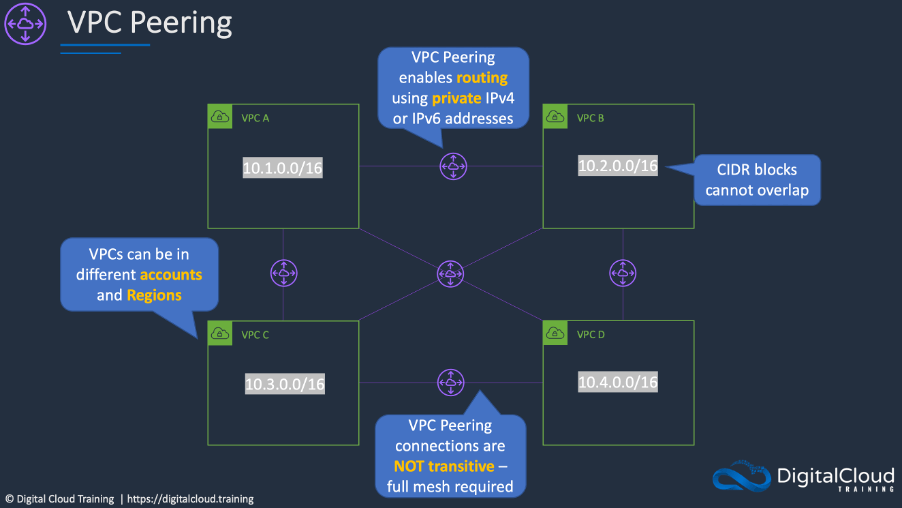
A VPC peering connection is a networking connection between two VPCs that enables you to route traffic between them using private IPv4 addresses or IPv6 addresses. Instances in either VPC can communicate with each other as if they are within the same network.

You can create a VPC peering connection between your own VPCs, or with a VPC in another AWS account. The VPCs can be in different regions (also known as an inter-region VPC peering connection).
A. “Create a VPC gateway endpoint for each EC2 instance and update route tables” is incorrect. You cannot create VPC gateway endpoints for Amazon EC2 instances. These are used with DynamoDB and S3 only.

B. “Attach a virtual private gateway to VPC-TEST1 and VPC-TEST2 and enable routing” is incorrect. You cannot create an AWS Managed VPN connection between two VPCs. 

C. “Attach a Direct Connect gateway to VPC-TEST1 and VPC-TEST2 and enable routing” is incorrect. Direct Connect gateway is used to connect a Direct Connect connection to multiple VPCs, it is not useful in this scenario as there is no Direct Connect connection.

References:

https://docs.aws.amazon.com/vpc/latest/peering/what-is-vpc-peering.html

https://digitalcloud.training/certification-training/aws-solutions-architect-associate/networking-and-content-delivery/amazon-vpc/

Question 2: A video production company is planning to move some of its workloads to the AWS Cloud. The company will require around 5 TB of storage for video processing with the maximum possible I/O performance. They also require over 400 TB of extremely durable storage for storing video files and 800 TB of storage for long-term archival. Which combinations of services should a Solutions Architect use to meet these requirements?

A. Amazon EC2 instance store for maximum performance, Amazon S3 for durable data storage, and Amazon S3 Glacier for archival storage.

B. Amazon EBS for maximum performance, Amazon S3 for durable data storage, and Amazon S3 Glacier for archival storage.

C. Amazon EC2 instance store for maximum performance, Amazon EFS for durable data storage, and Amazon S3 for archival storage.

D. Amazon EBS for maximum performance, Amazon EFS for durable data storage, and Amazon S3 Glacier for archival storage.

Item #2

The correct answer is A. “Amazon EC2 instance store for maximum performance, Amazon S3 for durable data storage, and Amazon S3 Glacier for archival storage”.

Explanation:

The best I/O performance can be achieved by using instance store volumes for the video processing. This is safe to use for use cases where the data can be recreated from the source files so this is a good use case.

For storing data durably Amazon S3 is a good fit as it provides 99.999999999% of durability. For archival the video files can then be moved to Amazon S3 Glacier which is a low-cost storage option that is ideal for long-term archival.

B. “Amazon EBS for maximum performance, Amazon S3 for durable data storage, and Amazon S3 Glacier for archival storage” is incorrect. EBS is not going to provide as much I/O performance as an instance store volume so is not the best choice for this use case.

C. “Amazon EC2 instance store for maximum performance, Amazon EFS for durable data storage and Amazon S3 for archival storage” is incorrect. EFS does not provide as much durability as Amazon S3 and will not be as cost-effective.

D. “Amazon EBS for maximum performance, Amazon EFS for durable data storage, and Amazon S3 Glacier for archival storage” is incorrect. EBS and EFS are not the best choices here as described above.

References:

https://docs.aws.amazon.com/AWSEC2/latest/UserGuide/InstanceStorage.html

https://aws.amazon.com/s3/storage-classes/

https://digitalcloud.training/certification-training/aws-solutions-architect-associate/storage/amazon-s3/

Question 3: A persistent database must be migrated from an on-premises server to an Amazon EC2 instances. The database requires 64,000 IOPS and, if possible, should be stored on a single Amazon EBS volume. Which solution should a Solutions Architect recommend?

A. Use an instance from the I3 I/O optimized family and leverage instance store storage to achieve the IOPS requirement.

B. Create an Amazon EC2 instance with four Amazon EBS General Purpose SSD (gp2) volumes attached. Max out the IOPS on each volume and use a RAID 0 stripe set.

C. Create a Nitro-based Amazon EC2 instance with an Amazon EBS Provisioned IOPS SSD (i01) volume

D. Create an Amazon EC2 instance with two Amazon EBS Provisioned IOPS SSD (i01) volumes attached. Provision 32,000 IOPS per volume and create a logical volume using the OS that aggregates the capacity.

Item #2

The correct answer is C. “Create a Nitro-based Amazon EC2 instance with an Amazon EBS Provisioned IOPS SSD (i01) volume attached. Provision 64,000 IOPS for the volume”.

Explanation:

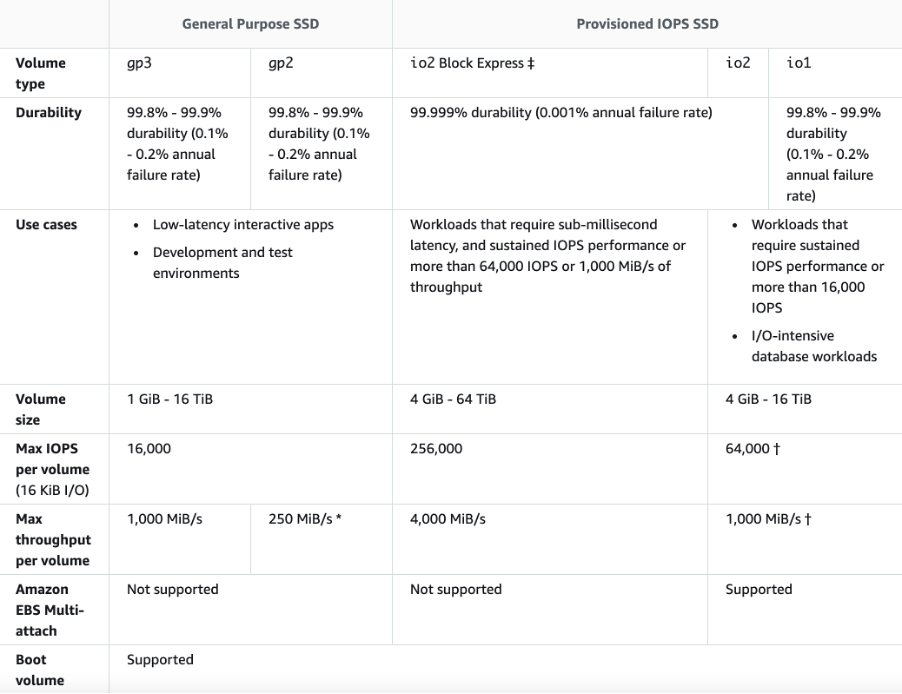
Amazon EC2 Nitro-based systems are not required for this solution but do offer advantages in performance that will help to maximize the usage of the EBS volume. For the data storage volume an i01 volume can support up to 64,000 IOPS so a single volume with sufficient capacity (50 IOPS per GiB) can be deliver the requirements.

The current list of EBS volume types is in the table below:
Free Practice Questions AWS

A. “Use an instance from the I3 I/O optimized family and leverage instance store storage to achieve the IOPS requirement” is incorrect.

B. “Create an Amazon EC2 instance with four Amazon EBS General Purpose SSD (gp2) volumes attached. Max out the IOPS on each volume and use a RAID 0 stripe set” is incorrect. This is not a good use case for gp2 volumes. It is much better to use io1 which also meets the requirement of having a single volume with 64,000 IOPS.

D. “Create an Amazon EC2 instance with two Amazon EBS Provisioned IOPS SSD (i01) volumes attached. Provision 32,000 IOPS per volume and create a logical volume using the OS that aggregates the capacity” is incorrect. There is no need to create two volumes and aggregate capacity through the OS, the Solutions Architect can simply create a single volume with 64,000 IOPS.

References:

https://docs.aws.amazon.com/AWSEC2/latest/UserGuide/ebs-volume-types.html

https://digitalcloud.training/certification-training/aws-solutions-architect-associate/compute/amazon-ec2/

Free AWS Solutions Architect Professional practice exam

Access free practice questions for the AWS Solutions Architect Professional with detailed answers and explanations

Exam coverage

This free AWS practice exam includes a mix of questions on core AWS services covering multiple knowledge areas

20 questions

Test your knowledge with 20 AWS practice questions that reflect the difficulty of the real AWS exam

Pass marks 72%

You need to get 14 out of the 20 Practice Questions right to pass this free AWS practice test. Good luck!

This free AWS practice exam for the AWS Solutions Architect Associate consists of 20 questions that include detailed answers and explanations. You’ll be presented with a mix of questions on core AWS services, including Amazon EC2, AWS Lambda and Amazon S3.

Please note that unlike our exam simulator, this free AWS practice test is not timed – so you can take as much time as required to answer each question. At the end of the AWS Solutions Architect practice exam, you get to review your answers and find detailed explanations why each answer is wrong or right along with reference links for each question. This will help you identify your strength and weaknesses.

How to best prepare for your AWS Solutions Architect Associate exam

Practice makes perfect! To maximize your chances of success, enroll in our training courses for the AWS Solutions Architect that include a video course, practice exams / exam simulator and training notes (PDF). 

The AWS Solutions Architect practice exam course consists of 6 full-length practice tests with 65 questions each.

Our practice exams are delivered in 4 different modes:

Exam mode (timed) 6 sets of practice exams with 25 questions each. Pass mark is 75%, time limit 60 mins. Shorter than the real exam to make it more manageable when studying.

Training mode (not timed): Check answers and explanations after every question.

Knowledge reviews (deep dive):  Collection of practice questions for a specific knowledge area that allows you to focus your efforts where they’re needed most.

Final exam simulator:  Full-length exam with 75 questions pulled randomly from our pool of questions. Delivered in training mode so you get to immediately reveal answers and explanations for every question.

Sign up for our monthly or yearly plans to access our popular AWS Solutions Architect PRO training – simply the best way to ensure you pass your exam the first time with a great score.

AWS Certified Solutions Architect Associate exam

Here are the most important facts about the official AWS Certified Solutions Architect Associate Exam (SAA-C03)
Exam Name AWS Certified Solutions Architect Associate
Exam CodeSAA-C03
Exam LevelAssociate
Exam Duration130 Minutes
Passing Score72%
Eligibility/Pre-requisiteNone
Validity3 years
Exam FormatMultiple choice or multiple response
Number of Questions65 Questions
Exam Fee$150
Exam LanguagesEnglish, French, German, Italian, Japanese, Korean, Portuguese, Simplified Chinese, Spanish
Exam Delivery FormatPearson VUE and PSI (testing center or online proctored exam)
Official Exam GuideDownload the Official Exam Guide